
Three paths, different costs
When credit is the obstacle and income is not, properties usually offer one of three routes. They are not equivalent, and which one is available is a property-level fact bad-credit locating tracks. If the obstacle is a score rather than the absence of a file, start with renting on a 580 credit score.
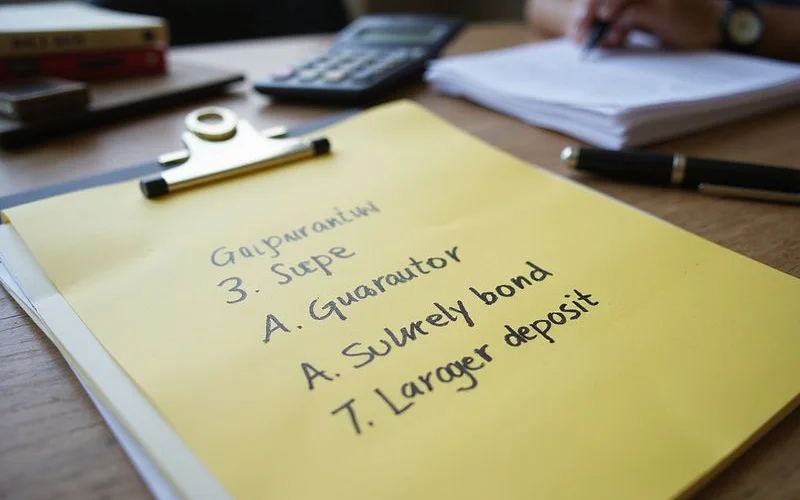
| Path | Upfront cost | Refundable | Who carries the risk |
|---|---|---|---|
| Higher deposit | Highest | Yes, subject to damage | You |
| Deposit alternative (surety) | Lowest | No | The surety provider |
| Guarantor | None | N/A | Your guarantor |
Higher deposit
The simplest. The property asks for more security — commonly 1.5x or 2x the standard deposit, occasionally a full month’s rent extra.
It costs the most at move-in and it is the only one of the three you get back. If you have the cash and you intend to leave the unit in good condition, it is usually the cheapest of the three in real terms.
Deposit alternative
A surety or bond product. You pay a smaller upfront amount or a monthly fee, and the provider covers the property up to a stated limit if you default or leave damage.
Two things to be clear about. It is not a deposit and none of it comes back. And it does not cap your liability — if there is damage, the provider pays the property and then pursues you.
Cheapest at move-in, most expensive over a long tenancy. Read what the monthly fee actually totals over the lease before choosing it for convenience.
Guarantor
Someone who signs the lease as financially responsible if you do not pay.
Property requirements vary, and the common ones are:
- Income at 4x or 5x the rent, higher than the resident multiple
- A credit score above a stated threshold
- Frequently a Texas residency requirement, which is the one that surprises out-of-state applicants
- A full application and screening, with its own fee
The guarantor is agreeing to a real obligation. It is worth them reading the guaranty document rather than just signing the page.
Not every property accepts one
Guarantor acceptance is a property-level policy. Lining one up before knowing whether the property takes guarantors is a common wasted step, and it is one of the things we check first.
Which to choose
Cash available, staying a while, unit likely to be returned clean. Higher deposit. You get it back.
Cash tight at move-in. Deposit alternative, with the total-over-lease cost calculated first.
No cash and someone willing and qualified. Guarantor, provided the property accepts one and your guarantor clears the multiple.
Two or more available. Ask which the property prefers. Some will reduce a deposit requirement if a guarantor is on the file.
What to send us
Your gross monthly income, target rent, rough credit range, whether a guarantor is available to you and roughly what they earn, and how much cash you can put down at move-in.
We filter to properties whose stated policies match the path that actually works for you, with the income multiple, deposit terms, and total monthly cost attached to each — the practical end of bad-credit locating.
Tell us your situation. We describe what properties require and never promise approval.